In flexible packaging converting, a machine brochure may list a top speed of 600 meters per minute, yet many lines never run anywhere near that figure on real film. Thin BOPP, PET and PE webs are light, slippery and quick to build static charge, and each of those traits makes the web sensitive to tension changes. A true high speed slitting cutting machine is therefore defined less by its nameplate and more by the stable speed at which it can produce acceptable rolls for hours at a time.
This guide approaches selection from the film side. It explains how substrate behavior shapes the cutting method, the rewinding design and the control architecture. It then shows how to verify a supplier's claims with a material trial, and closes with the information you should prepare before requesting a quote.
Flexible packaging films behave very differently from paper or metal foil. Their properties create several failure modes that become more severe as line speed rises. Understanding these properties is the first step in judging whether a machine is genuinely suited to your product.
Each property reduces the margin for error as speed increases. Acceleration and deceleration are the most dangerous moments, because the inertia of a large roll pushes against the web and the cutting station. A machine that handles steady running well may still produce defective rolls during these transitions.
The right machine configuration depends heavily on what you run. The matrix below is a practical first filter. Identify the row that matches your main product, then ask your supplier for trial data on that specific material rather than an average across all films.
| Film Type | Typical Thickness | Main Slitting Risk | Priority Focus |
|---|---|---|---|
| BOPP | 12 to 40 microns | Edge burrs and telescoping | Razor precision and smooth tension ramp |
| PET | 12 to 60 microns | Hard winding and wrinkles | Accurate taper tension and web guiding |
| PE | 20 to 100 microns | Static and trapped air | Static elimination and nip roll control |
| Laminates | 40 to 120 microns | Delamination and edge dust | Shear cutting and dust extraction |
Many converters run several substrates on the same line. In that case, the machine should be specified around the most demanding material, with recipes stored for each film so that tension and cutting parameters can be recalled rather than re-tuned by hand.
Razor slitting uses a pair of hardened blades pressed against a backing roller. It produces clean edges on BOPP and PET at high speed and is a common choice for lines running long orders with consistent widths. Blade life and edge quality depend on stable blade pressure and fine adjustment of the overlap, so the setup procedure matters as much as the blade material.
Shear slitting uses a rotating upper blade that passes a lower blade in a scissor action. It suits laminates, coated films and heavier PE, where a razor might smear or heat the edge. The trade-off is a slightly lower speed potential and more frequent checks of the blade gap. For many converters, that trade-off is worthwhile because it protects the value of the finished roll.
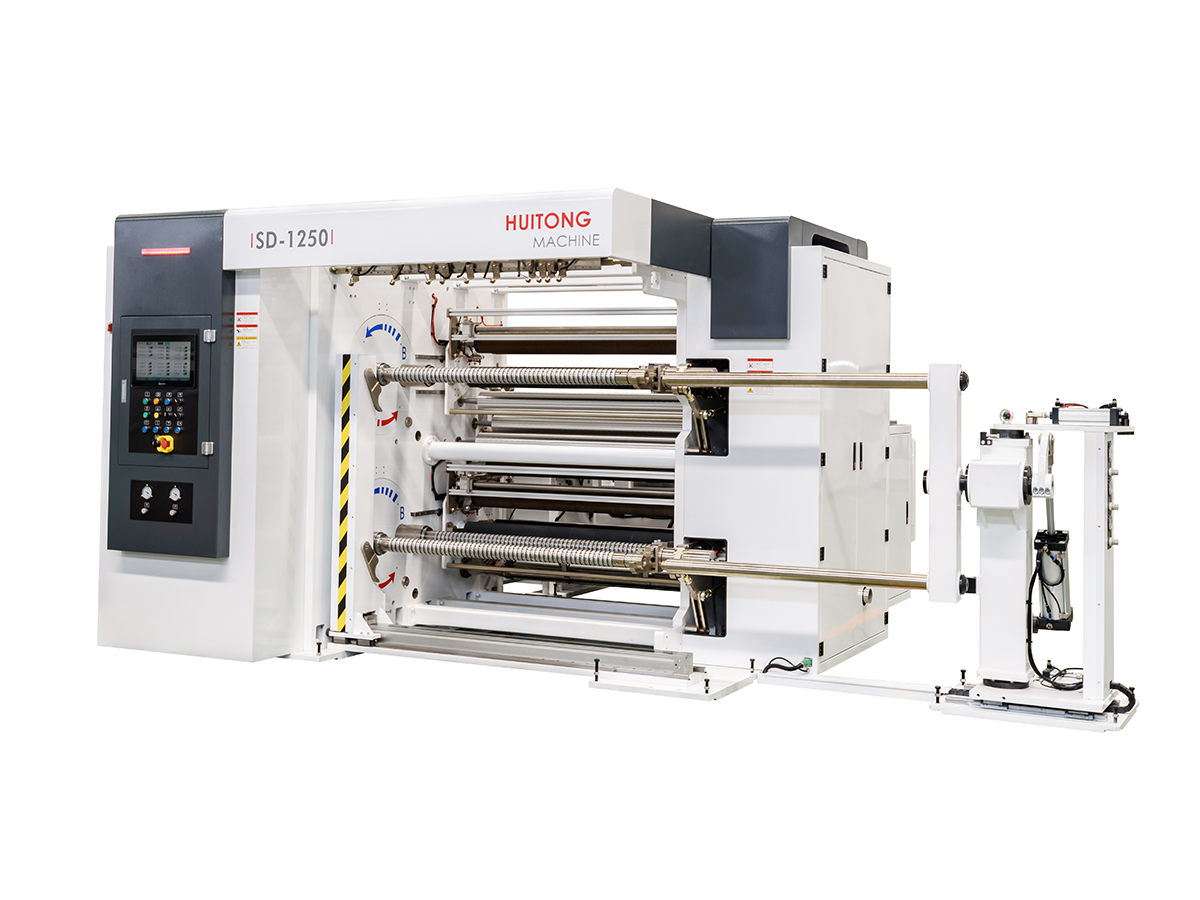
Speed on paper is worthless if the line stops for every roll change. A turret rewinder carries two or more winding shafts. While one roll is winding, the finished roll on the other shaft is removed and a new core is loaded. This keeps the web running almost continuously, and it is the main reason a well-designed high speed line delivers more monthly output than a faster machine that stops often.
An automated turret system typically offers several advantages:
When evaluating a slitting rewinder, ask the supplier to show the complete cycle time of a changeover, including threading, cutting and core handling. A fast machine with a slow manual changeover can lose more time than a slightly slower automated unit that never stops the web.
Tension is the variable that connects every other element of the machine. The unwind, the slitting station and the rewind must operate as one closed loop. A load cell or dancer roller measures tension, a controller compares the reading with the setpoint, and servo drives adjust torque many times per second to hold the web steady.
Taper tension is applied during winding so that roll hardness decreases as diameter increases. This prevents the inner layers from being crushed and reduces the risk of telescoping. Typical taper settings differ by film. PET often requires a steeper taper than BOPP, while PE benefits from a gentler profile to avoid air entrapment.
Web guiding with edge sensors keeps the film centered during acceleration and deceleration. Guiding accuracy matters most on thin films, where a small lateral shift can produce uneven rolls that are hard to correct downstream.
Empty-machine rotation speed tells you almost nothing about production capability. A reliable evaluation requires a trial with your own material, run at the speed you intend to use in daily production. The following steps reveal the performance that will matter after installation.
Run at target speed for a sustained period, not a short burst.
Check edge quality across at least one complete roll from start to finish.
Log each interruption, including threading and roll changes.
Ask for a written trial report that includes hardness readings, edge defect counts and stop logs. A supplier confident in its equipment should welcome this level of scrutiny, and the report becomes a useful baseline for acceptance testing after installation.
Precise information leads to a precise quote. Vague requests usually result in conservative configurations that either cost too much or fail to meet your speed target. Gather the following details before contacting suppliers.
When your specifications are ready, share them with a film slitting machine supplier so that engineers can review whether the proposed configuration matches your output target. A detailed request also makes it easier to compare offers on identical terms.
Rated speed and process speed are different things. BOPP often runs stably at a mid-range speed when tension and cutting are well tuned, while PE usually requires a lower sustained speed because of static and friction. The most useful answer comes from a trial on your own film, measuring the speed at which the product consistently meets specification over a full run.
Ionizing bars placed near the unwind and slitting zones are the most common solution. Controlling humidity in the production area, selecting low-friction or anti-stick rollers and maintaining proper nip pressure also reduce charge build-up. During a trial, check static levels by observing dust attraction on the finished rolls and by monitoring layer cling during rewinding.
The main cost drivers are the rewind configuration, the number of winding shafts, the quality of the servo system, the level of automation in roll changing and the depth of the tension and guiding package. Electrical components and build quality also affect long-term reliability. To compare quotes fairly, request them against identical specifications and identical trial terms.
Contact Us
Recommended Products
Joining Hands With Huitong
Customize Your Flexible Packaging Equipment Solution
Inquire now
Products
contact us

Tel: +86-0510-86328508
+86-0510-86324508
Mob: +86-13914908980
Email: [email protected]
ADD: No. 429 Xizhang Road, Gushan Town, Jiangyin City, Jiangsu Province, China

 English
 русский
 Español
 عربى