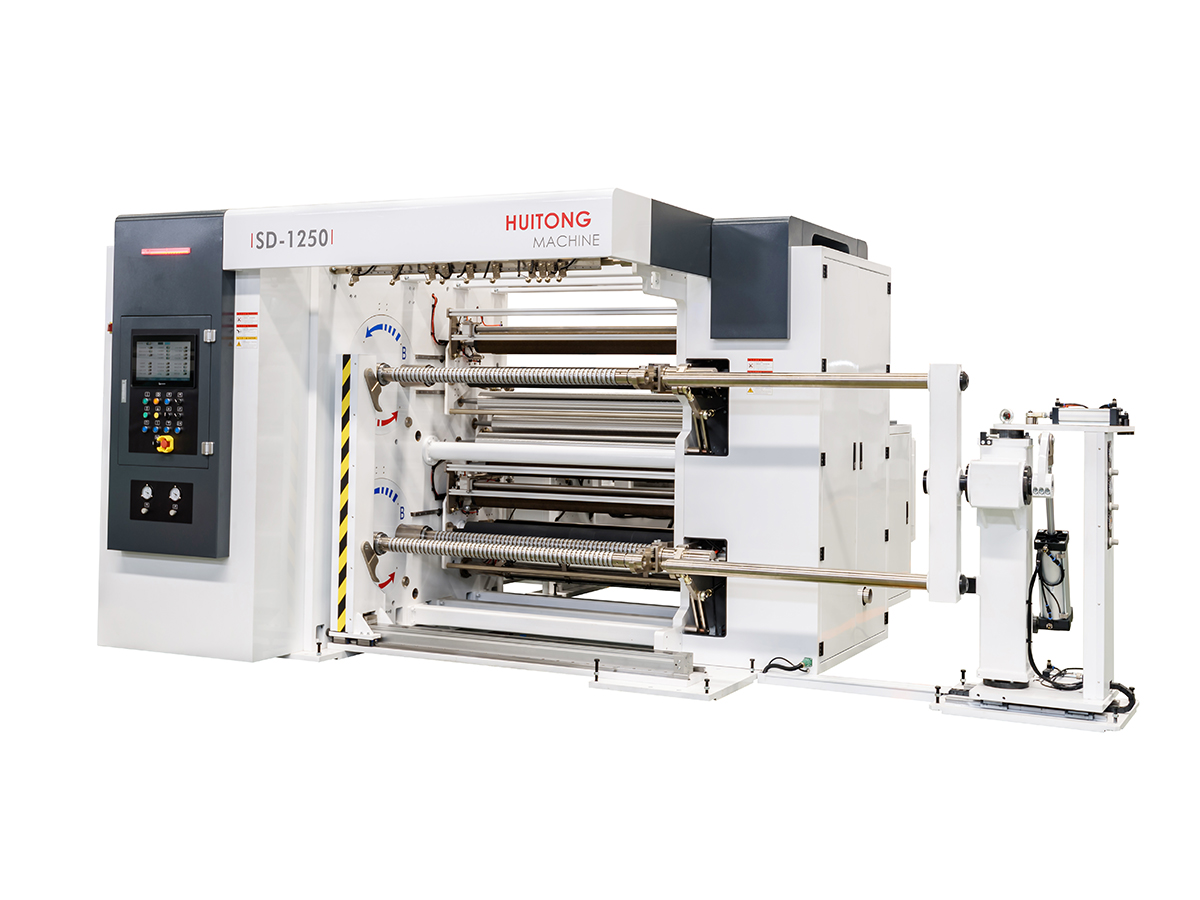
When evaluating a high speed slitting cutting machine, the safety question is not "which one feature?" but "how are hazards controlled at every level?" The definitive answer: you must insist on multiple, redundant protection layers—physical barriers, intelligent sensors, emergency stops, tension safeguards, and mandatory operator training. No single device guarantees safety; only a holistic system can prevent injuries during unwind, slitting, and rewind operations.
The fundamental safety element is the emergency stop (E‑stop) system. Every high speed slitting machine must have multiple E‑stop buttons positioned at the unwind, slitting zone, rewind, and all operator access points. Buttons must be large, red, and operable even with gloves.
Activation must cut power to all drives, brakes, and knives within 0.5 seconds—a standard requirement under EN 418. Some models also include foot‑operated pedals and pull‑cable emergency stops along the machine length, allowing operators to trigger a halt from any position. Daily functional checks of every E‑stop are non‑negotiable; a failed button is a critical violation.
All rotating shafts, knife holders, nip points, and winding rolls must be covered by fixed or interlocking guards. Fixed guards are bolted and require tools for removal, while interlocking guards are connected to the control circuit—opening any guard during operation instantly stops the machine.
Transparent polycarbonate shields over the slitting area provide visibility without compromising protection. Full enclosure of the entire slitting line, including the unwind and rewind stations, reduces noise, contains flying debris, and prevents accidental contact—a practice recommended by OSHA 29 CFR 1910.212.
Modern high speed slitting cutting machines integrate active sensor systems that detect human presence and trigger automatic shutdown without physical contact. Key technologies include:
These systems comply with ISO 13849 Performance Level d or e, ensuring a very low probability of failure. They compensate for human error and are especially valuable during setup and troubleshooting.
Tension control is often viewed as a quality parameter, but it is equally a critical safety feature. Uncontrolled tension leads to web breaks, material whipping, and sudden release of stored energy—all of which can cause severe lacerations or impact injuries.
A safe tension system must include:
In practice, tension‑related accidents account for nearly 30% of slitting line injuries (industry internal data), making this feature non‑negotiable for any responsible operator.
The slitting knives themselves are the obvious hazard. All blades must be fully guarded during operation, with covers that only expose the cutting edge when the machine is running. Additional blade‑specific safety measures include:
It is strictly prohibited to adjust knife positions or clean debris during high‑speed operation. All blade work must follow written procedures and be performed only after the machine has come to a complete stop and been locked out.
Hardware alone is insufficient. Every operator must complete formal, documented training covering machine layout, hazard recognition, emergency procedures, and proper use of personal protective equipment (PPE). Training should be repeated annually and after any machine modification.
Minimum PPE for high‑speed slitting operations:
Operators must pass a practical assessment before working independently. Refresher courses every six months help maintain awareness and adapt to any process changes.
A disciplined daily checklist is the backbone of a safe operation. Before starting any production run, verify:
Any discrepancy must be reported and corrected before production starts. Never bypass a safety device for the sake of productivity.
| Hazard | Corresponding Safety Feature | Applicable Standard |
| Rotating nip points & drive shafts | Fixed guards, interlocked enclosures | OSHA 1910.212 |
| Operator proximity to slitting zone | Light curtains, photoelectric sensors | ISO 13849 (PL d/e) |
| Emergency situations | Multiple E‑stops, foot pedals, pull‑cords | EN 418 / CE |
| Web break / tension loss | Closed‑loop tension control, auto‑stop on drop | EN 13418 |
| Blade contact | Retractable covers, LOTO, handling tools | ANSI B11.18 |
| Human error / lack of awareness | Formal training, PPE, warning labels | ISO 9001 / internal |
This layered model ensures redundancy and depth: if one layer fails, the next still protects. For instance, if a light curtain is bypassed, the physical guard still prevents access; if the guard is opened, the interlock shuts down the machine; and if the interlock fails, the operator can always hit an E‑stop.
When purchasing a high speed slitting cutting machine, verify that it carries the following certifications or meets the corresponding standards:
Compliance is not just about paperwork; it reflects the manufacturer’s commitment to building a truly safe machine. Never accept a machine that lacks these verifications.
In summary, when you evaluate a high speed slitting cutting machine, look for:
Speed and output are meaningless if operators are at risk. The high‑speed slitting machines are those that weave safety into every component, every control, and every procedure. Choose wisely—your team’s well‑being depends on it.
Contact Us
Recommended Products
Joining Hands With Huitong
Customize Your Flexible Packaging Equipment Solution
Inquire now
Products
contact us

Tel: +86-0510-86328508
+86-0510-86324508
Mob: +86-13914908980
Email: [email protected]
ADD: No. 429 Xizhang Road, Gushan Town, Jiangyin City, Jiangsu Province, China

 English
 русский
 Español
 عربى
عربى